Open Quad or Covered Walkway: Two Kinds of Shared Space
Compare an open quad with a covered walkway to see how shelter, sightlines and circulation shape comfortable pauses and clearer routes across campus.
The common mistake with an open quad or covered walkway is judging it from a photograph rather than noticing what people do there. A route that looks generous can still leave people unsure where to wait, while a striking campus view may hide the everyday work of crossing between buildings. At Trường Đại học Thủ Dầu Một, the useful question is not which form looks more welcoming, but how each fits the campus’s patterns of movement and gathering.
That question offers a distinct way to compare campus geography with casino culture. Instead of treating a casino passage as a model for campus design, consider how each setting gives visitors a different relationship to the wider place: a quad connects activity to its surroundings, while an interior passage may make the route itself the main experience. The contrast is about spatial character, not a claim that the two settings share the same purpose.
Quad and campus geography
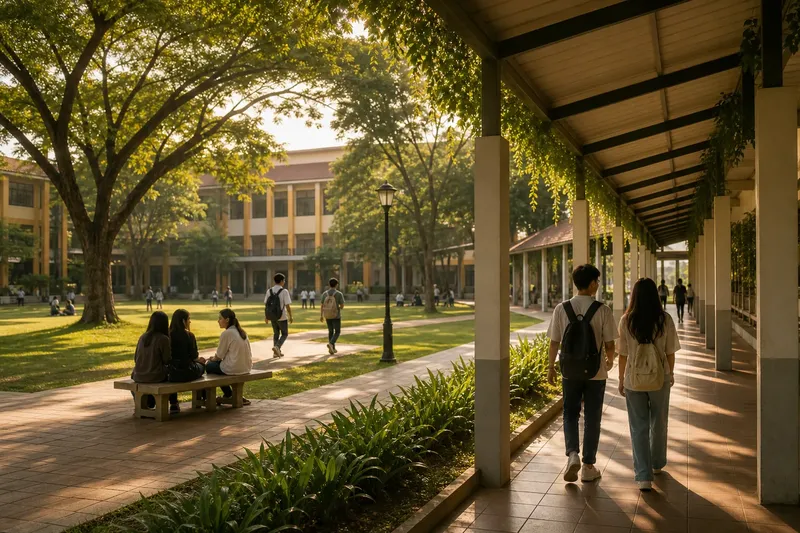
A quad can act as a reference point in a campus landscape. Its open centre gives nearby paths and buildings a shared frame, so someone crossing the grounds can locate themselves in relation to familiar edges. That role depends on what surrounds the space: building fronts, trees, paths and activity all contribute to its identity.
The same openness can make the centre feel like a stage. Someone waiting alone may prefer the edge, where a tree, wall or building frontage gives the pause a little context. The relevant design question is not simply whether the quad is open, but whether its edges offer different ways to be present: passing through, watching a gathering or joining it.
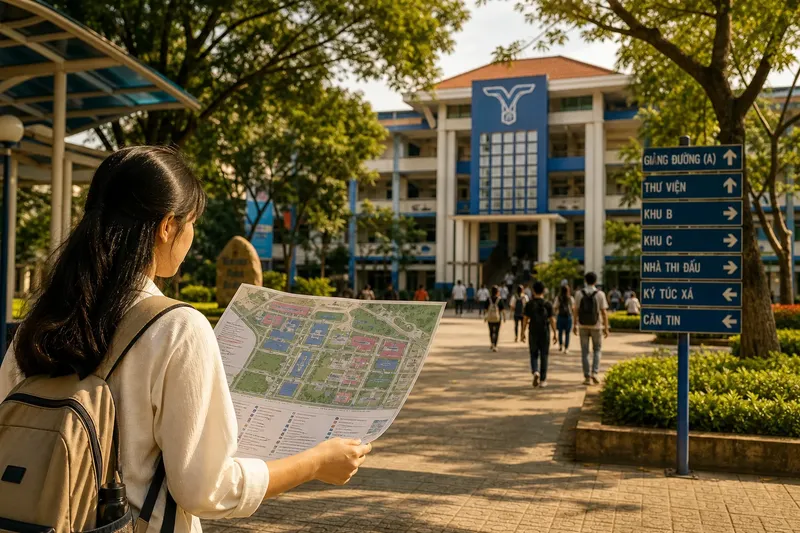
On a campus such as Trường Đại học Thủ Dầu Một, the quad also belongs to a larger network of destinations. A map can show connections, but the experience of moving between places depends on visible landmarks and recognisable paths. A distinctive tree line or a clear view of a building entrance may orient people more naturally than a decorative feature placed in the middle of a crossing.
Walkway as connector
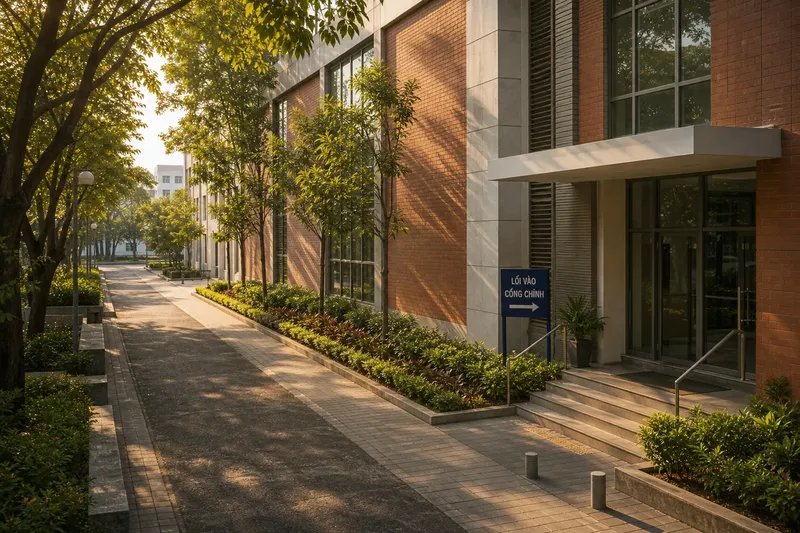
A covered walkway has a different job in the campus landscape: it links places while offering shelter along the way. Its character comes partly from what it reveals beyond the roof. A view towards a courtyard or a recognisable building can make the passage feel connected to the rest of campus rather than detached from it.
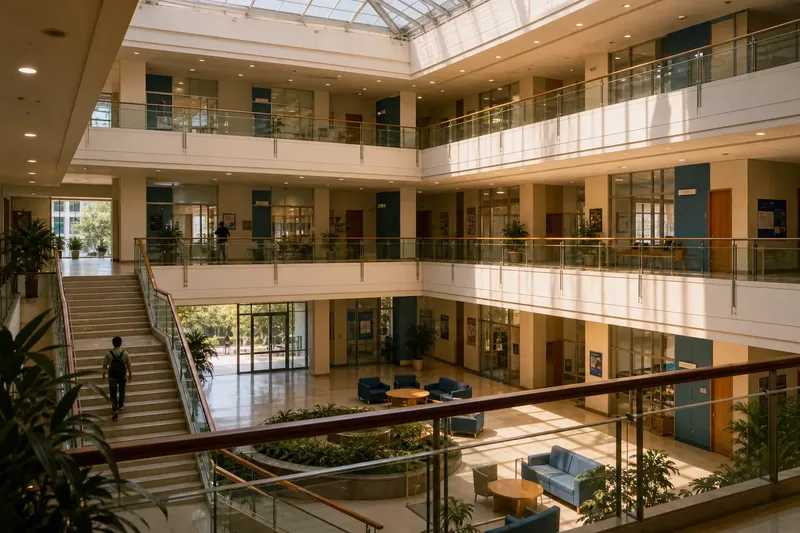
Casino interiors provide a useful contrast here. A passage inside a casino may be experienced chiefly as part of an interior sequence, shaped by its lighting, finishes and nearby activity. A university walkway, by comparison, can be read as a connector between distinct outdoor places. The comparison helps a reader notice how setting changes the meaning of a route without assuming that either space has a single universal effect.
These forms can also meet. A covered edge beside a quad may offer a sheltered place from which to look across the open space, while a path through the quad can connect buildings more directly. The design challenge is to make those relationships understandable: people should be able to recognise where a route leads and where a pause belongs.
Reading place and movement
Look beyond the centre line of a path. Notice where people naturally slow down, where they turn to identify a building, and which campus edges already attract brief conversations. These observations can reveal whether a space functions as a destination, a connector or both.
Say a campus team begins with these invented observations: people use a quad as a shortcut between two buildings, and visitors pause beside a covered walkway to orient themselves. The team marks the shortcut on a paper campus plan, then compares it with the visible paths on the ground. It places a simple directional sign at the walkway’s sheltered edge, away from the main line of travel. The expected observable result is a clearer distinction between the crossing and the place to stop and read; the trade-off is that the sign may be less visible from another approach, so the team checks whether that approach needs its own cue.
Not every pause needs furniture or a new feature. Sometimes it is enough to keep a view open or avoid placing a display where people already change direction. Elaborate paving patterns are not worth the effort if the basic relationship between destinations, paths and places to wait remains hard to read.
Campus space questions?
What makes a quad a landmark?
Its position among buildings, paths and recognisable features can make it a useful point of reference. If people can relate nearby destinations to its edges, the quad is doing more than providing an open area.
How does a covered walkway shape a campus route?
It connects places while giving the journey a distinct sheltered character. Views through or beyond it help people understand how the passage fits into the larger campus.
Why compare campus paths with casino interiors?
The comparison draws attention to how surroundings shape the experience of moving through a place. It is most useful as a contrast between an outdoor campus network and an interior sequence, not as a claim that their purposes are alike.
Where should a campus team begin?
Start by noting the paths people actually use and the places where they stop to orient themselves. If a pause repeatedly overlaps with movement, identify a nearby edge or sheltered spot that could serve it instead.
Practical design checks
- Check whether people can identify the quad’s main approaches; if a planted edge or display hides a route, then move the obstruction, otherwise keep the existing edge.
- Check whether the quad has a recognisable landmark from its approaches; if none is easy to identify, then consider highlighting an existing tree or building frontage, otherwise avoid adding a new feature.
- Check whether a walkway reveals where it leads; if a wall or sign blocks the view, then adjust the obstruction or add a directional cue, otherwise retain the clear view.
- Check whether people stop to orient themselves in the flow of the walkway; if they do, then place the information cue at a nearby sheltered edge, otherwise leave the current sign position.
- Check whether a route across the quad connects useful destinations; if people are cutting across an unmarked area, then consider clarifying that desire line, otherwise preserve the existing path network.
- Check whether a sheltered edge supports a brief pause without obscuring a campus landmark; if it does, then keep the pause point, otherwise shift it to a less obstructive edge.
Imagine a campus team with these invented starting inputs: one paper map showing two buildings, one observed diagonal crossing through the quad, and one directional sign beside the walkway entrance. First, the team draws the crossing on the map and checks that it connects the two buildings directly; the result is a marked desire line to retain. Next, it moves the sign to a sheltered edge beside the walkway and checks that it remains visible from the approach; the result is a place to pause that sits outside the crossing. Finally, the team compares the new arrangement with the original observations: if people can still find the sign and the crossing stays legible, it keeps the changes; if the sign is missed from another approach, it adds a cue there rather than moving the crossing. The trade-off is a slightly more distributed system of directions in exchange for keeping the quad’s central route clear.
Choosing a spatial role
An open quad is most legible when its paths, edges and landmarks make its place in the campus network easy to understand. A covered walkway is most useful when it connects destinations without losing its relationship to the spaces around it. A campus may need both, but each should respond to the activity and geography of its location rather than copy the visual language of a different kind of venue.
For readers considering Trường Đại học Thủ Dầu Một alongside casino culture, the distinction is a way to read place: campus space often links open grounds and shared destinations, while a casino interior can foreground the passage through its own enclosed setting. The main search phrase, open quad or covered walkway, is therefore less a contest than a prompt to ask what the route connects, what the edges make visible and where a person can pause without losing their bearings.