The Grand Entrance Is Not the Whole Building
Campus entrance reading at Trường Đại học Thủ Dầu Một reveals how doors, paths and planted edges shape a building’s boundary, without guessing how people use it.

The common mistake in campus entrance reading is to focus on the grand front door and miss how the building meets its surroundings along the edges. At Trường Đại học Thủ Dầu Một, that narrow view can flatten a campus landscape into a façade and conceal the quieter boundaries around it.
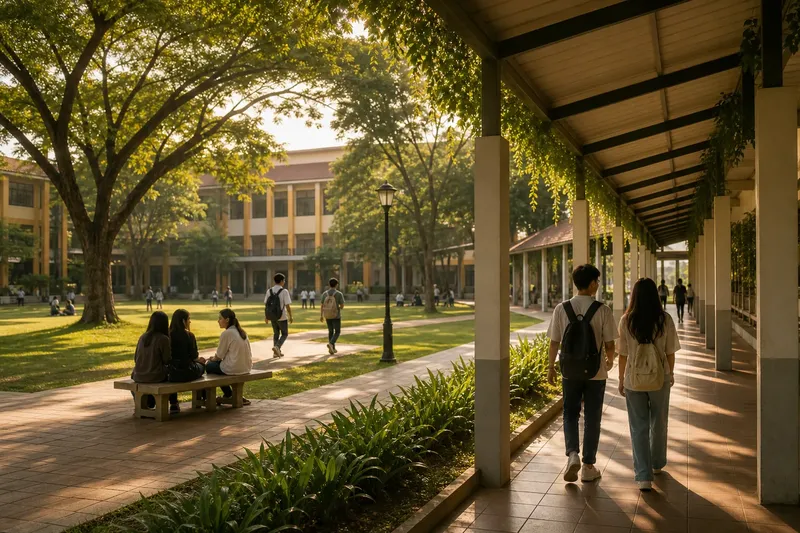
A more useful reading starts with what is visible: the shift from open ground to wall, the way a path ends or bends, and the changes in paving, planting or shelter. These details describe the campus’s built edges without turning them into claims about access, behaviour or purpose.
Start with the boundary
Choose a building that can be viewed from a public route. From a spot where you can see the façade and its edges, note where paving meets planting, where a wall changes direction and whether a canopy extends beyond the building line. A quick sketch can record these relationships without pretending to be a measured plan.
Look for the boundary as a sequence rather than a single line. A low wall may give way to a planted strip; a covered passage may link the building to an open court; a path may run alongside a blank façade before turning away. Describe each visible change before suggesting what it might mean.
Do not assume that a door or path is open to everyone. Signs and barriers can clarify what is permitted, but an unclear edge is not an invitation to explore behind the building. Stay on public routes and follow posted instructions.
Read paths and edges
Trace how paths meet the building. Does paving lead directly to a wall, pass beside it, or turn towards a visible entrance? Note where the surface changes and whether planting, a kerb, a ramp or steps interrupt the route. The aim is to record the relationship, not to rank routes by convenience.
Edges also shape what can be seen. A row of trees may partly screen a ground-floor wall; a glass frontage may make an interior visible from outside; a fence may separate a planted area from a path. These are observations about the campus landscape, not proof of how any space is used.
For this subject, it is not worth calculating a path’s exact length or trying to infer footfall from a brief visit. A clear description of where the route goes and what borders it is more useful than unsupported precision.
Record visible details
Use a small set of concrete notes to keep a campus edge reading grounded. For each item, record what you can see and let that observation guide the next decision:
- Observe whether a sign names an entrance; if it does, record its wording and position, then avoid claiming that everyone uses that entrance.
- Observe whether a barrier blocks a path; if it does, stay on the public side and describe the boundary, then choose another permitted viewpoint rather than crossing it.
- Observe whether paving meets a planted strip; if it does, mark the transition in your sketch, then describe it as a material change rather than evidence of access.
- Observe whether a path ends at a wall; if it does, record where it stops, then do not treat it as a route through the building.
- Observe whether a canopy projects over an edge; if it does, note the sheltered area it visibly covers, then avoid assuming who uses it or for how long.
- Observe whether a façade is partly screened by trees; if it is, note which part remains visible, then describe the screening without assigning it a fixed symbolic meaning.
- Observe whether steps, a ramp or a level-looking path appears at an approach; if one is visible, record that feature, then do not infer full accessibility from appearance alone.
Build a boundary reading
Say you are examining an invented campus building with a straight public path beside its western wall. Your starting notes record one canopy over the front entrance, a planted strip along the wall and a sign directing visitors to the main entrance. You sketch the path, mark the strip and copy the sign’s wording. The resulting account can say that the front is formally identified for visitors while the western edge meets the path through planting. It cannot establish whether the side is used, whether the planted strip can be crossed or how busy either route is.
This approach also keeps comparisons with casino culture specific. A casino-inspired film set, for instance, can be discussed in terms of its visible frontage, materials or screening, but those features should not be treated as evidence that a university landscape shares its purpose or rules. Compare what is shown, not what you imagine happening behind the boundary.
Questions about campus edges?
What counts as a campus boundary?
A boundary can be a wall, planting strip, fence, paving change or the point where a covered passage meets open ground. Describe the feature you can see and where it meets the public route.
How should I record an unclear path?
Note where it begins, where it ends and what lies beside it, using a sketch if that helps. If its access status is unclear, remain on the public route rather than treating its appearance as permission.
Can I infer how a space is used?
A visible sign may state a space’s intended access, but appearance alone cannot establish how people use it. Keep your account to observable features unless reliable, explicit information supports a broader claim.
How does this differ from reading a frontage?
A frontage reading concentrates on the building’s outward-facing presentation. A boundary reading follows how the building meets paths, planting and other edges beyond that face.
Keep descriptions grounded
When writing about campus entrance reading, favour precise descriptions over dramatic interpretations. “The path runs beside a planted strip and stops at a wall” stays close to what is visible; “the wall hides a private route” adds a claim the scene may not support.
At Trường Đại học Thủ Dầu Một, a careful account of edges can make a campus building legible without assigning every feature a fixed meaning. Leave uncertain access uncertain, and let the small, observable details carry the description.