Tracing a Campus-to-Casino Film Route Without Inventing the Map
Trace a campus-to-casino film route through turns, pauses and edits, so you can see how the scene guides a character without inventing unseen spaces.
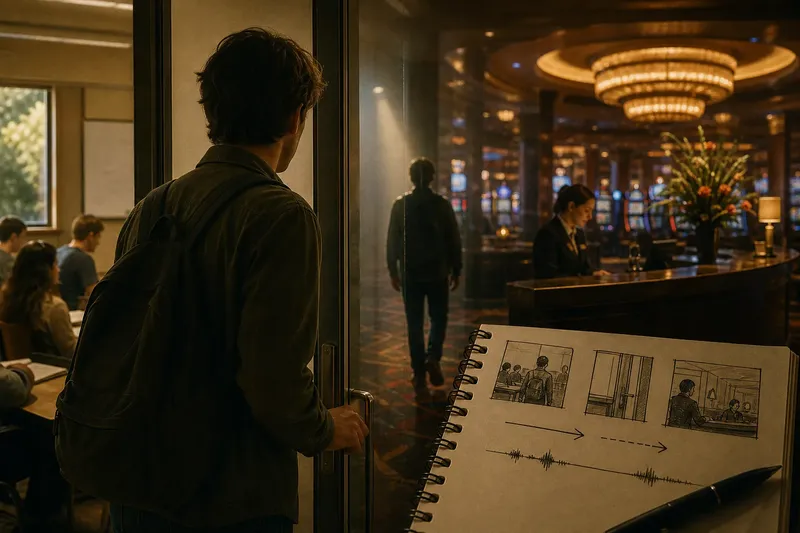
The common mistake in tracing a campus-to-casino film route is to treat every cut as a doorway. That shortcut costs you the scene’s real design: a character may appear to cross town, slip next door or vanish into an unknown gap, and the edit may never tell you which.
Instead of building another speculative campus map, follow the scene’s attention. Note what the camera makes prominent, what it lets drop out of sight and how sound nudges the viewer towards a connection. A screen and a notes app are enough; the useful result is a clear account of how the sequence steers perception, not a floor plan.
Choose a revealing sequence
Pick a short passage in which a character moves between contrasting settings, such as a seminar room and a casino reception area, or a campus path and a gaming lounge. The locations can remain unnamed. What matters is that the film gives you a change in light, sound, surface or social activity to notice.
Watch once without pausing. Write down the first image, the last image and the moment the sequence changes direction or mood. On a second viewing, note the edit points and any repeated visual or sound cues. You are not asking, “Where is this building?” but “How does this sequence make the next place feel connected to the last?”
Track the edit’s invitations
A film can connect places through more than a visible route. A character’s glance may point towards the next shot; a sound can continue across a cut; a repeated colour or shape can make two unrelated interiors feel like parts of one journey. These are invitations to connect images, not proof that the fictional spaces share a wall or passage.
Make a small table in your notes with three columns: what appears, what changes at the cut, and what connection the edit invites. For instance, “glass door in frame” can lead to “cut before the door opens” and then to “the next room feels like a destination, but the route is withheld”. This keeps the film’s visual argument in view without pretending to know more than it shows.
Read thresholds as choices
Doors, lifts, gates and corridor corners can make a character’s decision legible. A hand on a handle may hold the viewer in suspense; a quick turn may suggest an attempt to avoid someone; a threshold crossed without pause can make a change of setting feel routine. The same physical detail can carry different meanings depending on timing, framing and what happens just before it.
Record the action before interpreting it. “Stops at the lift” is a visible event; “fears being followed” is a possible reading. Look for a supporting cue, such as a glance behind, a voice from off-screen or a change in pace. If no cue settles the matter, leave the motive open.
Sound and framing
Listen for sounds that bridge or divide locations. An announcement that continues over a cut may stitch the images together, while a sudden burst of gaming-floor noise can make the new setting arrive before the character does. Note whether the source is visible, implied or unclear.
Framing has its own geography. A wide shot may display several exits and invite the viewer to anticipate a route; a close-up can withhold the surroundings and turn a simple pause into a mystery. A character leaving the frame does not tell you where they went. The camera may simply have chosen another detail.
Questions about film routes?
How long should the scene be?
Choose a sequence short enough to replay without losing track of its changes, but long enough to include a threshold or an edit between settings. A compact passage with a clear opening and ending usually gives you more to work with than a location montage.
Should I draw a route map?
Draw one only if it helps you track what is shown. Use solid arrows for movement the film makes clear and a broken line for a connection suggested by editing, sound or a glance; leave the rest blank.
What if the character’s direction is unclear?
Mark the direction as unknown and check the shots immediately before and after the cut for a repeated landmark or a change in gaze. If the film supplies no reliable cue, preserve that uncertainty rather than choosing a route for it.
A worked viewing
Imagine an invented sequence: a student leaves a seminar room, stops beside a glass door, and appears in the next shot near a casino reception desk. On the first viewing, the starting point is the seminar room and the ending point is the reception area. On the second, you note that the character glances back, the door never opens on screen, and a low mechanical hum continues across the cut.
Now write the route as three separate observations: the student exits the room; the film cuts before showing a passage; the student appears at reception while the hum persists. The resulting reading is specific but modest: the edit links departure and arrival, and the sound smooths the transition, while the actual journey remains unknown. That distinction is the point, not a gap to fill.
Keep the notes selective
For a final pass, check each note and choose what to do with it:
- Visible movement: If a continuous shot shows the character crossing a doorway, record the crossing as a demonstrated link; if the shot cuts first, leave the route unresolved.
- Repeated landmark: If the same sign, window or sculpture appears on both sides of an edit, note the visual echo; if it does not recur, do not use it to claim a shared location.
- Sound bridge: If a sound clearly continues across the cut, mark it as a connection in the soundtrack; if its source is uncertain, describe the sound without assigning it to a room.
- Pause at a threshold: If a glance, gesture or approaching person accompanies the pause, record that cue before suggesting a motive; if no cue appears, leave the character’s reason open.
- Off-screen exit: If the character leaves the frame, note the last visible direction; if no destination follows, do not extend the route beyond the image.
- Changing camera view: If a wide shot reveals several exits, note the choices available to the viewer; if a close-up hides them, describe the restriction rather than inventing unseen corridors.
Exact distances, frame-by-frame pausing and attempts to identify a real university building from a fleeting glimpse are not worth the effort here. They add labour without clarifying how the scene directs attention. A few well-chosen cues—a held doorway, a sound that crosses an edit, a cut that hides a journey—will tell you more about the film’s construction.
When you revisit your first notes, separate three things: the character’s visible action, the camera’s choice of what to reveal and the connection you infer. That is a useful way to read any campus-to-casino film route: not as a map waiting to be completed, but as a sequence that decides which links the viewer can see and which must remain uncertain.